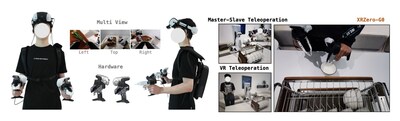
Xiaomi has made a significant contribution to the embodied AI community by open-sourcing the complete real-world post-training pipeline for its Vision-Language-Action (VLA) large model, Xiaomi-Robotics-0.
The open-source release covers the full pipeline from data collection to model fine-tuning, enabling researchers and developers to replicate and build upon Xiaomi's approach. The team demonstrated that with just approximately 20 hours of task-specific data, a robot could master complex precision tasks such as earphone storage — an operation requiring sub-millimeter alignment accuracy.
This represents a dramatic reduction in the data requirements for skill acquisition. Traditional robot programming often requires thousands of hours of demonstrations or extensive reinforcement learning in simulation. Xiaomi's approach shows that with the right post-training methodology, robots can learn complex skills from relatively modest amounts of real-world data.
"The key insight is that pre-trained VLA models already possess a strong understanding of physics and object interactions," the Xiaomi robotics team explained. "Post-training bridges the gap between general knowledge and task-specific execution, and we are sharing this process openly to accelerate the entire field."
The open-source release includes the training scripts, data processing pipelines, evaluation protocols, and hardware configuration details. This level of transparency is expected to significantly lower the barrier for embodied AI research and development globally.
By democratizing access to advanced VLA post-training techniques, Xiaomi aims to foster a more collaborative ecosystem where progress in robot learning can compound across institutions and applications. The release has been met with widespread enthusiasm in the robotics community, with many researchers noting that detailed post-training methodologies have been a critical missing piece in the open-source embodied AI landscape.