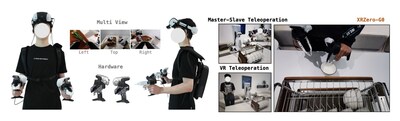
ByteDance's Seed team has officially launched GR-3, a next-generation Vision-Language-Action (VLA) model designed for general-purpose robotic manipulation, marking a significant step toward a truly universal robot brain.
Unlike traditional robotic manipulation models that rely on massive amounts of trajectory data for training, GR-3 demonstrates breakthrough capabilities in understanding language instructions that include abstract concepts, and precisely handling flexible objects such as cables, fabrics, and soft materials — tasks that have long challenged conventional robotics.
The model exhibits strong few-shot generalization abilities, allowing it to quickly adapt to new tasks and recognize novel objects with minimal additional training data. This represents a fundamental shift from rigid, task-specific robot programming toward flexible, language-driven robot control.
"GR-3 is designed as a general-purpose robot brain that can understand what you want and figure out how to do it," the ByteDance Seed team stated. The model bridges the gap between high-level language understanding and low-level motor control, enabling robots to perform complex manipulation sequences autonomously.
The achievement is seen as a critical advancement toward embodied AI systems that can operate in unstructured environments — homes, warehouses, and healthcare settings — where tasks are varied and unpredictable. By combining visual perception, natural language comprehension, and action generation in a single unified framework, GR-3 moves beyond the limitations of earlier VLA architectures that required extensive task-specific fine-tuning.
Industry analysts view this release as further validation that VLA models are becoming the dominant paradigm for robot intelligence, with Chinese tech giants like ByteDance joining global leaders in the race toward general-purpose embodied AI.