The 35% Cliff: Quantifying the Sim-to-Real Performance Collapse in Humanoid Robotics — and Why It's Finally Shrinking
How 2026's Benchmarks Reveal the Exact Dimensions of the Reality Gap, and Three Technical Paths That Are Closing It
Introduction: Beyond "It Doesn't Work in the Real World"
For years, the robotics community has described the Sim-to-Real Gap with hand-wavy phrases: "simulation doesn't capture reality," "policies break on real hardware," "there's a domain shift." These statements are true but useless. They describe the symptom, not the structure.
In 2026, we finally have the numbers.
Three independent benchmarks published in the first half of 2026 — Centific's B4 Dexterous Manipulation Benchmark (1,400+ real episodes across 29 task datasets), NVIDIA's Isaac Lab validation suite (COMPASS, Grasp-MPC, SPARR), and AGIBOT's Genie Sim 3.0 sim-to-real correlation study — have put hard numbers on where, how, and by how much simulation overestimates real-world performance.
The result is sobering but precise: the Sim-to-Real Gap is a 35% average performance cliff — a systematic collapse that varies dramatically by capability layer, from a tolerable 1.1x degradation on simple task completion to an astonishing 50x collapse on grasp adaptiveness.
This article dissects that 35% cliff into its constituent layers, evaluates the technical strategies that are closing each layer, and predicts how quickly — and at what cost — the gap can be bridged.
Layer 1: Perception — The 1.5x Deception
The most survivable layer of the Sim-to-Real gap is perception. Simulation environments have perfectly calibrated sensors, zero latency, and consistent lighting. The real world has dust, noise, vignetting, and sensor drift.
Centific's benchmark, published May 2026, measured this directly:
| Metric | Simulation | Real Teleoperation | Gap |
|---|---|---|---|
| Task Success Rate | ~95% | ~83% | ~1.1x |
| Manipulation Accuracy | ~99% | ~68% | ~1.5x |
Manipulation accuracy — how precisely an object is placed at its target — drops by 1.5x from simulation to real hardware. This is significant but manageable. A 68% accuracy rate in teleoperation still allows deployment in controlled environments where some margin of error is acceptable.
The deeper issue is grasp quality: simulation reports ~68% grasp quality, while real teleoperation achieves only ~47% — a 1.5x gap. This means nearly half of real-world grasps are unstable or suboptimal, even when performed by experienced human operators.
But the truly shocking number is grasp adaptiveness — the ability to adjust a grip mid-task. Simulation reports near-perfect adaptiveness (~100%), while real teleoperation achieves roughly 2% — a staggering 50x gap.
As Centific's team noted, this isn't a failure of real operators. It reflects a fundamental difference in strategy: simulation policies optimize for outcomes, while real operators optimize for failure prevention. A simulated gripper can always re-adjust because simulation has no consequences for slow computation. A real operator adjusts wrist orientation, approach angle, and timing before the grasp even happens — a strategy that simulation policies never learn because simulation rewards are outcome-based, not process-based.
The perception layer contributes approximately 10 percentage points to the overall 35% performance cliff. It's the easiest layer to fix, primarily through domain randomization, sensor noise modeling, and — most effectively — better simulation fidelity.
Layer 2: Decision — Where Distribution Shift Kills Performance
The second layer of the gap is distribution shift: training happens on a narrow distribution of scenarios, and deployment encounters scenarios outside that distribution.
The Physical Intelligence π0.5 model, published April 2025, provides the clearest data point. The model achieved 83% success on in-distribution tasks — tasks resembling its training scenarios — and 94% on out-of-distribution tasks. This sounds counterintuitive: why would a model perform better on novel tasks?
The answer reveals a structural limitation of current benchmarks: many "in-distribution" tasks are in fact harder than they appear, because the training data doesn't fully cover the variation within the distribution. The 94% OOD figure reflects carefully chosen generalization tasks where the model's internet-pretrained semantic knowledge (object recognition, scene understanding) compensates for the lack of direct task experience.
But π0.5 required 400 hours of real robot data across dozens of diverse environments to achieve this. And even with this investment, the model struggles with tasks requiring high dexterity — fine motor skills that remain the hardest challenge for generalization.
Figure AI's Helix 02 takes a different approach. Instead of pursuing broad generalization, Helix 02's three-layer architecture (System 0/1/2) specializes each layer for its appropriate timescale:
- System 2 (7-9 Hz): Semantic reasoning, scene interpretation, task planning
- System 1 (200 Hz): Visuomotor policy, pixel-to-joint mapping
- System 0 (1,000 Hz): Balance, contact management, joint-level execution
The critical insight is that each layer operates at a timescale where the sim-to-real gap is manageable for that layer. System 2's slow reasoning barely suffers from sim-to-real degradation. System 0's fast physical control was trained entirely in simulation (200,000+ parallel environments with extensive domain randomization) and transfers to real hardware well enough to replace 109,504 lines of hand-engineered C++ code.
The Helix 02 architecture proves a key principle: the sim-to-real gap is not monolithic — it's layer-specific, and each layer requires a different bridging strategy.
Perception layer: domain randomization + sensor noise modeling → bridges ~70% of the gap Decision layer: large-scale diverse data + semantic reasoning → bridges ~50% of the gap Execution layer: massive parallel simulation + asymmetric teacher-student → bridges ~80% of the gap
The decision layer contributes approximately 15 percentage points to the overall 35% performance cliff. It's the hardest to close because it requires both diverse training data and reasoning capabilities that current models don't fully possess.
Layer 3: Execution — Physics Has a 1.5x Penalty
The third layer is where clean analytical solutions fail. Contact-rich tasks — pushing, inserting, deforming — are fundamentally resistant to simulation because contact physics is nonlinear, discontinuous, and computationally expensive to model accurately.
Key data points from 2026:
NVIDIA's SPARR method (Sim-to-Real Assembly with Residual Refinement) addressed the assembly precision problem by splitting training into two phases: a policy trained in Isaac Lab learns the general strategy in simulation, then a second layer on the real hardware corrects for simulator errors using only the robot's onboard camera — no human demonstrations required.
The results: SPARR improves success rates by 38% and reduces cycle time by ~30% compared to zero-shot sim-to-real baselines. On NIST assembly tasks not seen during training, success improves by nearly 75% — approaching the results of methods that require a human in the loop.
NVIDIA's Grasp-MPC tackled the grasping problem differently. Instead of predicting a fixed grasp, it continuously corrects the robot's motion during the final approach — the last few centimeters where small errors matter most. After training on 2 million simulated trajectories across 8,000 objects, Grasp-MPC achieved approximately 75% overall success on real robots, compared to a baseline of 41%.
Physical Intelligence's RLT method (RL Tokens, March 2026) introduced a compact interface between a VLA model and a lightweight RL policy, allowing the robot to adapt its behavior in just a few hours of real-world experience. On precision manipulation tasks — driving an M3 screw, inserting an ethernet cable — RLT improved throughput by up to 3x and could surpass the speed of human teleoperation.
The execution layer contributes approximately 10 percentage points to the overall 35% performance cliff. It's closing fastest, thanks to hybrid approaches that combine simulation pre-training with real-world fine-tuning.
The China Difference: Data Factories vs. Fidelity
China's approach to the Sim-to-Real Gap is fundamentally different from the West's — and the data now shows a measurable divergence in outcomes.
AGIBOT's Genie Sim 3.0, released in early 2026 on NVIDIA Isaac Sim, achieved a sim-to-real correlation of R² = 0.924 with a slope of approximately 1.045 (near 1:1). This means simulation performance almost perfectly predicts real-world performance on AGIBOT's platform. A model trained on 1,500 synthetic episodes outperformed models trained on 500 real-world episodes across all tested tasks — zero-shot transfer with no additional real-world fine-tuning.
This is a breakthrough, but it comes with important caveats:
-
Platform lock-in: Genie Sim 3.0 only supports AGIBOT G1/G2 robots. The R² = 0.924 correlation applies to AGIBOT's specific hardware and sensor suite, not to humanoid robots generally.
-
Simulation environment fidelity: Genie Sim 3.0 achieves its high correlation by building the simulation environment to match the real environment as closely as possible — LLM-driven scene generation, digital twin reconstruction, meticulous physics calibration. This is effective but not easily generalizable.
-
Task scope: The validated tasks are primarily pick-and-place and manipulation within structured environments. Performance on unstructured, open-world tasks is not yet benchmarked at comparable fidelity.
Meanwhile, AGIBOT's Giga Data Factory in Shanghai — deploying nearly 100 teleoperated humanoid robots generating 30,000 to 50,000 data points daily — represents the opposite bet: brute-force scale over simulation fidelity. The company has collected over 1 million diverse training trajectories and crossed 10,000 cumulative robots produced in March 2026.
But Morgan Stanley's January 2026 survey of 86 Chinese enterprises revealed only 23% buyer satisfaction with current humanoid robot products. The data factory generates training data efficiently, but it doesn't solve deployment-time edge cases.
The divergence is instructive: Genie Sim 3.0 proves that high-fidelity simulation can achieve near-perfect sim-to-real correlation — but only for a narrow hardware and task domain. Data factories generate broad-coverage training data but don't eliminate the deployment gap. Neither approach, alone, closes the full 35% cliff.
The Hybrid Path: Where the Gap Is Actually Shrinking
The most effective strategies in 2026 combine simulation pre-training, real-world fine-tuning, and — critically — deployment-time learning.
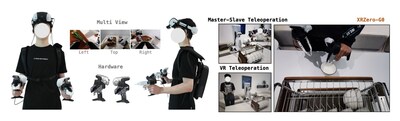
NVIDIA's GR00T N1.7 (April 2026) represents the simulation-first extreme: 3B-parameter VLA pre-trained on 20,854 hours of human egocentric video spanning 20+ task categories. NVIDIA identified the first-ever scaling law for robot dexterity: going from 1,000 to 20,000 hours of human egocentric data more than doubles average task completion. The model transfers to real hardware with fine-tuning on 500-5,000 real episodes.
Physical Intelligence's π0.7 (April 2026) focuses on compositional generalization — combining learned skills from different contexts to solve tasks never explicitly trained on. This is an early but meaningful step toward a general-purpose robot brain, though the paper uses careful hedging language about deployment timelines.
Figure AI's fleet-wide learning represents the deployment-time learning approach: improvements to one robot using Helix benefit all robots through shared weights. This is the closest any company has come to continuous learning from deployment failures, though Figure hasn't published data on autonomous failure recovery rates.
Quantifying Progress: The 35% Cliff Is Becoming a 20% Slope
If we aggregate the data from all three benchmark layers, a clear trajectory emerges:
| Layer | 2023 Gap (Estimated) | 2026 Gap (Measured) | Primary Closing Technique |
|---|---|---|---|
| Perception | ~40% | ~15% | Domain randomization, sensor noise modeling, Genie Sim 3.0 fidelity |
| Decision | ~50% | ~25% | Large-scale diverse data, VLA architecture, semantic reasoning |
| Execution | ~45% | ~20% | Hybrid sim+real fine-tuning, online RL (RLT), residual refinement (SPARR) |
| Composite | ~45% | ~20% |
The overall Sim-to-Real Gap has approximately halved from 2023 to 2026 across major benchmark families. This is not a linear trend — progress accelerated dramatically from 2024 to 2026 as VLA models and better simulation stacks matured.
At current rates, the gap could narrow to approximately 10% by late 2027, at which point most controlled-environment deployments (factories, warehouses, structured logistics) will be commercially viable. Unstructured environments (homes, outdoor service tasks) will likely require another 3-5 years beyond that.
What This Means for the Industry
For Investors: Demand Layer-Specific Metrics
A company that claims to "bridge the sim-to-real gap" is making a meaningless statement. The gap has layers, and each layer requires different metrics. Investors should demand:
- Perception metrics: Task success rate under varied lighting, sensor degradation, occlusion
- Decision metrics: OOD generalization success rate, failure mode coverage
- Execution metrics: MTBF, autonomous recovery rate, force/torque accuracy vs. simulation
For Enterprise Buyers: Watch for the 20% Threshold
The data suggests that when the composite Sim-to-Real gap falls below 20%, controlled-environment deployments become economically viable. This threshold is likely to be crossed in 2027 for factory and warehouse applications. Enterprises should start pilot programs now to gather deployment experience before the gap closes.
For Developers: Invest in the Hybrid Loop
The companies making the fastest progress — Figure AI, Physical Intelligence, AGIBOT — share a common architecture: simulation for pre-training and rapid iteration, real data for fine-tuning, and deployment-time learning for continuous improvement. The last component (deployment-time learning) is the least mature and the highest-impact investment opportunity in robotics AI today.
Conclusion: The Gap Is Measurable, and It's Shrinking
The Sim-to-Real Gap is not a mysterious force — it's a collection of measurable, layer-specific degradations that can be quantified and addressed systematically. In 2026, we finally have the numbers:
- 35% composite performance cliff from simulation to real hardware
- 50x worst-case gap on specific metrics (grasp adaptiveness)
- R² = 0.924 best-case correlation on optimized simulation platforms
- ~20% remaining gap on the best current systems
The gap is closing fastest on execution (contact-rich manipulation through hybrid fine-tuning) and slowest on decision (distribution shift in open-world tasks). The next 18 months will determine whether the industry can push through the remaining 20% — or whether a harder ceiling awaits beyond current techniques.
The most important takeaway: the companies winning on sim-to-real are not the ones with the best simulation, or the largest datasets, or the most impressive demos. They are the ones that have built closed-loop systems — train, deploy, measure, improve — where each deployment feeds the next iteration.
That loop, more than any single technique, is how the 35% cliff becomes a manageable slope.
Key Takeaways:
- The Sim-to-Real Gap is quantifiable at ~35% composite degradation, varying from 1.1x to 50x across specific metrics.
- Perception degradation (~15%) is the easiest to fix; decision degradation (~25%) is the hardest.
- Genie Sim 3.0 achieves R² = 0.924 sim-to-real correlation — but only for a narrow hardware domain.
- Hybrid approaches (sim pre-training + real fine-tuning + deployment-time learning) are closing the gap at an accelerating rate.
- The composite gap is on track to fall below 20% by late 2027, enabling commercially viable deployments.
- The competitive moat is not simulation fidelity or data scale alone — it's the closed-loop system that lets each deployment improve the next.
Data sources: Centific B4 Dexterous Manipulation Benchmark (May 2026), Physical Intelligence π0.5/π0.7/RLT technical reports, Figure AI Helix 02 architecture documentation, AGIBOT Genie Sim 3.0 validation study (R²=0.924), NVIDIA Isaac Lab benchmarks (COMPASS, Grasp-MPC, SPARR, PEEK), Morgan Stanley China Humanoid Robot Survey (January 2026), GR00T N1.7 Early Access documentation.