A new research paper demonstrates that humanoid robots can learn to distinguish self from others through proprioceptive-visual correspondence, without identity labels or kinematic models. Once established, this distinction bootstraps a predictive self-model that maps joint configurations to 3D body occupancy. In multi-agent scenarios involving humans or morphologically identical robots, the system reliably identifies itself, learns a 3D self-model, and supports downstream tasks including target reaching, collision-aware motion planning, and human-to-robot motion retargeting.

ResearchJune 12, 2026•Yurun Chen et al.
Researchers Enable Humanoid Robots to Distinguish Self from Others Using Proprioceptive-Visual Correspondence
New research shows humanoid robots can learn self-other distinction from proprioceptive-visual correspondence, enabling predictive self-models and collision-aware planning.
#humanoid#robotics#social-intelligence#self-model#arxiv
Reading in English
Language: English- Showing content in English
Trending Now

Industry
LG CNS and LX Pantos Partner to Build Next-Generation Unmanned Warehouse with Humanoid Robots
Jun 11, 2026 · 0 views
Research
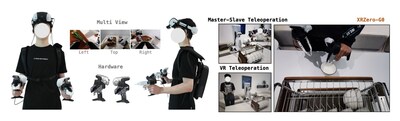
X Square Robot Open-Sources XRZero-G0 Framework for Scalable Robot Learning
Jun 10, 2026 · 0 views
Research
Human Archive Raises $8.2M to Train Robots Using India's Gig Economy Workers
Jun 7, 2026 · 0 views
Industry
The Economist Highlights Ningbo as the Unlikely Heart of Global Humanoid Robot Component Supply Chain
Jun 7, 2026 · 0 views
More in Research
Research
GenHOI: Zero-Shot Humanoid-Object Interaction by Imitating Generated Videos
Jun 13, 2026
Research
MIT Ultrasound Wristband Tracks Every Finger Movement, Controls Robot Hand in Real Time
Jun 13, 2026
Research
Generalist AI Unveils GEN-0: Embodied Foundation Model That Scales with Physical Interaction
Jun 13, 2026