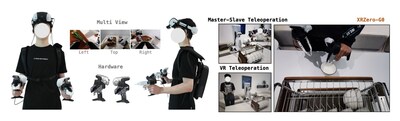
Generalist AI, an embodied intelligence company founded by former Google DeepMind senior research scientist Pete Florence, has unveiled GEN-0, a new class of embodied foundation model that establishes predictable scaling laws for robotics a milestone the field has long sought.
GEN-0 is trained directly on 270,000+ hours of high-fidelity real-world manipulation data not simulation, not internet video and demonstrates for the first time that robot intelligence can predictably scale with more data and compute, mirroring the scaling laws that powered large language models.
The model exhibits a critical phase transition at 7 billion parameters, which the team calls the ossification threshold. Below this threshold, models become rigid when exposed to large datasets and stop learning. Above it, performance continues to improve predictably with additional data, following clear power-law relationships between pretraining data volume and downstream task success rates.
GEN-0 is built on a novel architecture called Harmonic Reasoning, which allows robots to process sensory information and act simultaneously. Traditional robotic systems pause to plan each move; GEN-0 processes perception and action as continuous, intertwined streams much like how humans do not stop walking to think about where to place their next step.
This cross-embodied design enables a single model to be deployed across heterogeneous robot platforms from 6-degree-of-freedom robotic arms to 16+ degree-of-freedom semi-humanoid robots without retraining for each hardware type.
Post-training with minimal task-specific data achieves success rates up to 99% on new manipulation tasks. The 10B+ parameter model variant demonstrates robust generalization across 16 task categories including folding laundry, assembling camera kits, sorting Lego pieces, and other complex household and industrial operations.
The company data pipeline continues to grow at approximately 10,000 hours per week, suggesting further scaling could unlock even greater capabilities establishing GEN-0 as a foundational step toward general-purpose physical intelligence.