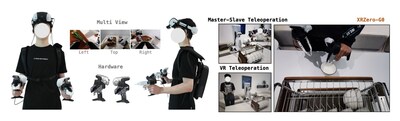
A team of researchers has published work on Predictive Style Matching (PSM), presenting a novel approach to enhance the naturalness of humanoid robot locomotion. The research addresses a critical challenge in humanoid robotics: achieving fluid, human-like movement that maintains both style and robustness.
The core innovation of PSM is an offline predictor that maps the robot's lower-body state history and velocity commands to upper-body joint and gait targets. This predictor is used only during training, allowing the deployed controller to maintain the same proprioceptive interface and inference cost as standard task RL approaches. This means PSM adds no computational overhead during actual robot operation.
Evaluated on the Unitree G1 humanoid robot, PSM achieves approximately an order of magnitude reduction in upper-body style error while maintaining fall recovery rates comparable to standard approaches. In contrast, motion imitation baselines, while achieving the lowest style error, suffer from a 5x higher fall recovery failure rate. This research represents a significant advance in making humanoid robots move more naturally without sacrificing stability.