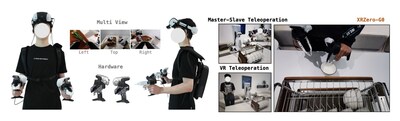
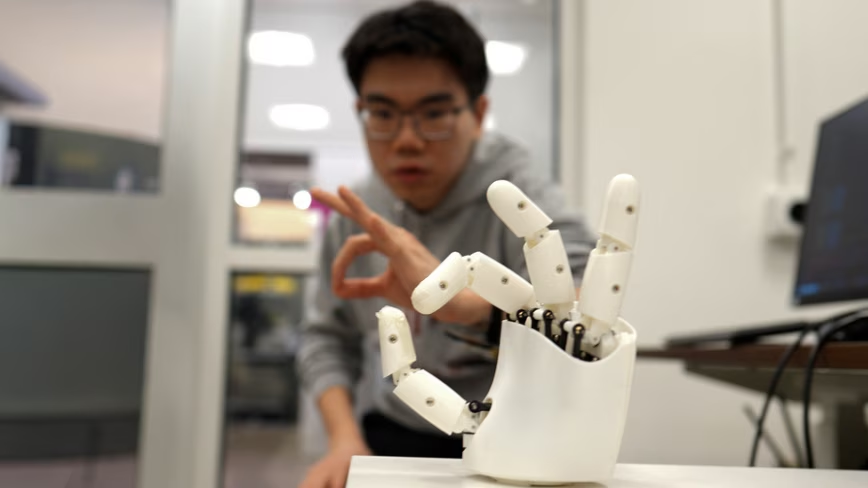
Researchers have introduced Human2Humanoid, an unsupervised motion retargeting framework designed to bridge the morphological gap between humans and humanoid robots.
The Challenge of Cross-Morphology Retargeting
Retargeting human motion to humanoid robots is critical for teleoperation, imitation learning, and human-robot interaction. However, substantial morphological discrepancies—including skeletal topology differences, limb proportions, and degrees of freedom—make this challenging without paired motion data.
Technical Approach
The framework employs three key innovations:
- CycleGAN-based architecture with skeleton-aware graph convolutional networks to capture topology-dependent motion features
- Morphology-invariant end-effector consistency loss that aligns normalized end-effector trajectories to preserve motion semantics
- Physics-aware feasibility constraints that encourage reproduction of contact patterns in source motion
Experimental Results
The framework successfully retargets human motion to Unitree G1 without paired data and outperforms existing methods in:
- Downstream controllability
- Physical feasibility
- Contact pattern preservation
Significance
This work enables rapid deployment of human-like motions to humanoid platforms without expensive data collection, significantly accelerating the development of expressive and natural humanoid robots.