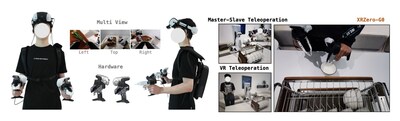
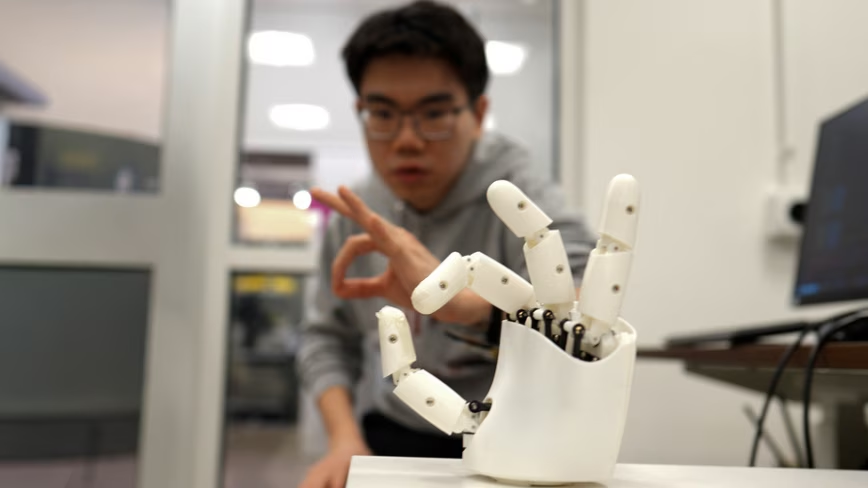
Researchers from the University of Science and Technology of China have developed a bionic generation-to-control framework for exemplar-driven style transfer on humanoid robots, enabling expressive and natural whole-body motion generation.
The Challenge of Expressive Motion
Expressive whole-body motion is crucial for humanoid robots operating in social, service, and human-coexistence environments. Most expressive motions are still obtained from fixed demonstrations or manually designed scripts, making it difficult to reuse demonstrated styles across different motion contents.
Technical Innovation
The framework introduces:
- Physics-aware multi-condition latent diffusion model that fuses style, content, and trajectory conditions
- Classifier-free guidance to adjust style intensity without retraining
- Contact-consistency and temporal-smoothness regularization to improve hardware executability
- Cluster-and-distill training strategy for the whole-body tracking policy
Key Results
- 96.0% success rate over 125 real-robot trials on Unitree G1
- Reduces contact and jitter artifacts compared to animation-oriented baselines
- Transfers short human style exemplars to diverse robot motion contents
- Preserves intended motion content while expressing human-derived styles
Applications
This technology enables humanoid robots to adopt natural human movement styles for various tasks, from service interactions to industrial applications, significantly enhancing their ability to integrate seamlessly into human environments.