The Industry's Billion-Dollar Debate
At the 8th Beijing Academy of AI (BAAI) Conference held June 12-13, 2026, an exclusive CEO forum brought together five leaders from China's most valuable embodied AI companies — each valued at over $1 billion.
The panel featured: Han Fengtao (CEO, Qianxun Intelligence), Zhu Xing (CEO, Ant Lingbo Technology), Xu Huazhe (Founder, Poké Robot), Zhou Yong (Founder, Lingxin Qiaoshou), and Liu Dong (Founder, Xingyuanzhi).
Stockpile Ammunition or Chase Revenue?
A central divide emerged between those advocating for capital preservation and those pushing for early commercialization.
Han Fengtao argued that current fundraising is primarily about "stockpiling ammunition." With embodied AI entering large-scale pre-training phase, capital burn will accelerate dramatically. "If you haven't secured top-tier funding and valuation this year, next year will be extremely difficult," he warned.
Liu Dong proposed a 70/30 split — 70% reserved as strategic capital, 30% for select commercial deployments, particularly in industrial automation.
Zhou Yong offered a contrasting view, suggesting the current wave isn't even a funding boom yet — it's merely a prelude. He estimated valuations are currently based on 10,000-unit shipments; when manufacturers reach 100,000 units, capital requirements will be 10x higher.
The 'Child Labor' Debate on Deployment
The most heated exchange centered on whether to rush deployment. Han Fengtao cautioned against premature scaling, comparing current embodied AI capabilities to a "1-2 year old child." He argued that deploying immature models is akin to "child labor" — counterproductive and costly.
"Large language models have reached 'graduate student' capability level, enabling low-cost deployment. Embodied models are nowhere near that," Han explained. His conservative estimate: true large-scale deployment is still about two years away.
Others pushed back. Liu Dong argued that model training must run in parallel with real-world scenario exploration, as the 1-2 year磨合 cycle is unavoidable. Zhu Xing predicted a physical-native foundation model could emerge by year-end.
Key Industry Predictions
The CEOs collectively identified three major transformations expected within the next year:
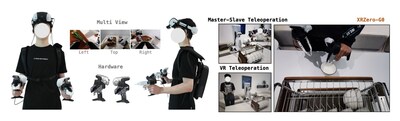
- Data Collection Shift: From robot-teleoperation-based collection to human-centric collection (wearable devices, gloves, head-mounted cameras)
- Model Paradigm Shift: Full transition toward embodied world models
- Deployment Milestone: 2027 identified as the元年 (first year) of large-scale robot deployment
Hardware Readiness Scorecard
Han Fengtao provided a revealing assessment of current robotics hardware readiness, assuming perfect humanoid capability = 100 points:
- Industrial robotic arms / surgical robots: 50 points
- Wheeled chassis: 40 points
- Quadruped robots: 30 points
- Biped robots: 15 points
- Dexterous hands: 5 points
- AI capabilities: 3 points (but with potential to reach 30-50 with large models)
The consensus: hardware is further along than AI — and AI improvement will in turn enable hardware upgrades.