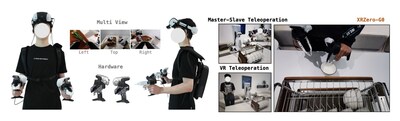
NVIDIA's GEAR (Generalist Embodied Agent Research) Lab, led by Jim Fan, has unveiled ENPIRE (Agentic Robot Policy Self-Improvement in the Real World), a groundbreaking system that enables AI coding agents to autonomously conduct real-world robotics experiments — without human intervention.
What ENPIRE Does
ENPIRE represents the first time that AI agents have been deployed to autonomously run the full cycle of robotics research in the physical world. Given a fleet of robots, a pool of GPUs, and a token budget, the system's AI agents automatically:
- Set up environments: Auto-reset scenes and auto-judge success/failure
- Improve manipulation policies: Progressing from heuristic methods to behavior cloning to reinforcement learning
- Run experiments on real robots: Collect data autonomously
- Analyze failures and iterate code: Identify root causes and modify code for the next round
Impressive Results
ENPIRE was tested on several high-precision manipulation tasks — including pin insertion, cable tie threading, cable tie cutting with scissors, and GPU installation onto motherboards. The autonomously trained policies achieved 99% success rate (pass@8 standard).
Physical Scaling Law
The project discovered what researchers called a "physical scaling law": deploying 8 parallel robot setups accelerated research progress significantly faster than 1 or 4 robots. The AI agents could also reference each other's successful strategies, similar to multiple researchers collaborating on the same problem.
However, scaling also came with costs — total token consumption grew super-linearly as agents spent increasing time reading and understanding other agents' progress.
Multi-Agent Support
ENPIRE tested three coding agent platforms: OpenAI's Codex (with GPT-5.5), Anthropic's Claude Code (with Opus 4.7), and Moonshot AI's Kimi Code (with Kimi K2.6). All three successfully completed the full workflow, though with varying research velocity across different tasks.
Knowledge Transfer
A notable finding was that when agents were asked to summarize their learned experiences into Markdown documents, these written summaries could be transferred to new tasks — effectively enabling cross-task knowledge migration at the methodology level, not just model parameters.
ENPIRE is fully open-source, allowing robotics labs worldwide to replicate the autonomous experiment framework and dramatically reduce the manual labor of running robot experiments.