Chinese embodied AI world model company Qianjue Technology has completed a Series A funding round worth hundreds of millions of RMB. The round was led by Jingming Capital, with participation from Shandong New Momentum and Shandong Caijin Capital. The investors include national-level funds and industrial partners. Maple Pledge served as the private equity financial advisor.
Founded in June 2023, Qianjue Technology's core team originated from Tsinghua University's Brain Research Center. The company focuses on embodied AI decision-making and planning large model development, enabling robots to achieve dynamic environment adaptation and fully autonomous operations.
The company has adopted a "predictive world model" approach, contrasting with mainstream generative methods that rely on pixel-level reconstruction. CEO Gao Haichuan explained that generative approaches face "feature pollution" problems since real-world images contain large amounts of irrelevant noise. To achieve pixel-perfect reconstruction, models bind effective features with ineffective information, making internal representations less "pure."
Qianjue's predictive model approach focuses on predicting low-dimensional evolution trajectories of physical states. Just as humans predict ball trajectory to swing a racket without imagining clear video frames, robots only need to anticipate "where the next state should go." The model outputs low-dimensional abstract features that directly decode into motion trajectories or planning instructions.
The company has also proposed a distributed predictive architecture, similar to brain region connections in humans. This architecture first distributes information across different regions, then compresses and predicts separately, achieving higher sample efficiency and faster inference speed while reducing demonstration data needed for robots to adapt to new scenarios.
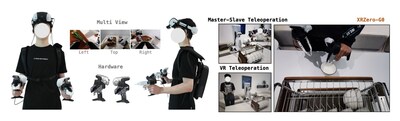
In applications, Qianjue decouples the embodied "brain" from the "cerebellum." The world model handles perception, prediction, and planning without binding to specific action spaces. The same "brain" can quickly migrate to different embodiments, reducing migration costs and accelerating data flywheel loops. The company has completed multi-category hardware adaptation with its self-developed embodied brain, with real-world projects deployed across multiple sites, and over 100,000 terminal devices connected.
The new funding will be used to build the self-developed world model architecture, algorithm iteration, and scenario implementation. The company will also expand its core R&D and project delivery teams, improve commercialization capabilities, and leverage massive terminal-generated real interaction data to further iterate the world model.