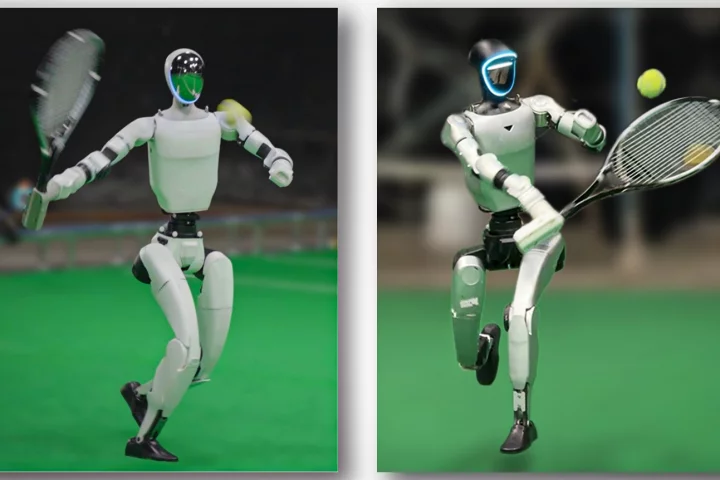
At ICRA 2026 in Vienna, NVIDIA Research presented 28 accepted papers—eight of which specifically demonstrated how simulation-to-real (sim-to-real) transfer is helping robots perceive, reason, plan, and act in dynamic environments. The message is clear: training in high-fidelity simulation is becoming the scalable foundation for generalizable, reliable embodied autonomy.
Key breakthroughs include: ScheduleStream, achieving 3x faster multi-arm planning by running computations on GPUs; COMPASS, a cross-embodiment navigation policy delivering ~80% real-world success across mobile robots and humanoids with a 4.5x improvement over baselines; and PEEK, a vision-language attention mechanism that produced a remarkable 41x real-world accuracy improvement by filtering out visual distractors.
Other highlights: Grasp-MPC achieved ~75% adaptive grasping success vs. 41% baseline using 2 million simulated trajectories; SEAL closed the reasoning-action gap with up to 15% accuracy gains by simulating candidate actions before execution; Refinery demonstrated 91% simulation success for multi-part assembly; and vision-based sim-to-real RL enabled dexterous humanoid tasks including bimanual handovers on unseen objects.
The research leverages NVIDIA's full robotics stack—Isaac GR00T, Cosmos world models, Newton physics engine, and Jetson edge AI—turning simulation into a practical, end-to-end development environment for embodied AI.