Researchers from Carnegie Mellon University (CMU) and Waseda University have introduced FACTR 2, featuring two key innovations — NEXT (Neural External Torque Estimation) and FIRST (Force-Informed Re-Sampling Training) — that bring force-aware capabilities to off-the-shelf robot arms without any additional sensing hardware.
Contact-rich manipulation tasks require force sensitivity, but most robot arms lack dedicated force-torque sensors due to their high cost. This limitation has been a significant barrier to deploying advanced manipulation policies on affordable robot platforms.
NEXT: Force Sensing Without Dedicated Sensors
NEXT is a data-driven method that estimates external joint torques using only joint state information. It requires only 10 minutes of free-motion data collection and 1 minute of training, yet achieves estimates comparable to dedicated joint-torque sensors. The method works by training an LSTM to predict the robot's free-space torque from joint states, then subtracting this prediction from measured motor torque at deployment to obtain external torque estimates.
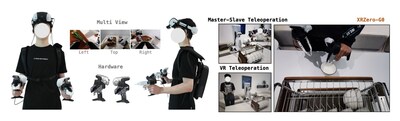
NEXT enables force-feedback teleoperation on low-cost arms and produces clean external contact signals suitable for real-time control applications.
FIRST: Better Policy Learning Through Force Awareness
Building on NEXT's torque estimates, FIRST (Force-Informed Re-Sampling Training) improves behavior cloning by re-sampling the training batch distribution to up-sample pre-contact and contact segments — the critical phases where force awareness matters most.
Across five long-horizon manipulation tasks, FIRST outperforms prior force-aware policies by over 17% in task progress, demonstrating that even approximate force information from learned estimators can significantly enhance policy learning.
The work has significant implications for democratizing force-aware robotics: it brings force-feedback teleoperation and policy learning capabilities to commodity robot arms without requiring expensive dedicated sensors, potentially accelerating the deployment of advanced manipulation in manufacturing, logistics, and service robotics.